


Farina (originally called Government Gums) is a historic outback town located in northern South Australia, roughly 600 kilometres north of Adelaide. It sits just off the iconic Oodnadatta Track, between Lyndhurst and Marree, in a remote and rugged landscape that was once a key transport and supply route for early settlers, railway workers, and pastoralists. Surrounded by wide open plains and red desert country, Farina’s location highlights both the challenges faced by its original inhabitants and the resilience required to live and work in such an isolated part of Australia. Although the town is now a collection of ruins and restored buildings, its position along major outback travel routes makes it a popular stopping point for travellers exploring the region.
Farina is Latin for flour or meal. The name was chosen in the 1870s by European settlers who believed the region might one day become productive wheat-growing land.
Our club has volunteered at Farina for the past couple of years, and prior to that we had visited many times as part of our regular travels. Each return trip has strengthened our connection to the place and deepened our appreciation for its history and the people dedicated to preserving it.
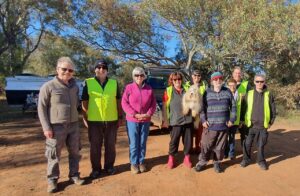
Volunteering at Farina has become a meaningful way for our members to give back to the community. It’s rewarding to know that the work we do contributes to a lasting legacy through the restoration and upkeep of the historic buildings. Over the years, our members have rolled up their sleeves and taken on a wide range of tasks—everything from stonework and helping out in the bakery to greeting visitors, providing information, and even managing rubbish duty.
No matter the job, everyone approaches it with enthusiasm, camaraderie, and a shared sense of purpose. Our time at Farina has not only supported an important heritage site but also brought our club closer together through teamwork and the simple joy of doing something worthwhile.
The Farina Restoration Group was formed in 2008.
The first working-bee (volunteer restoration program) happened in 2009, when about 30 people travelled to Farina for two weeks to begin restoration work.
The Farina Restoration Project Group is a volunteer-driven organisation dedicated to preserving and revitalising the historic outback town of Farina. Once a thriving railway and farming community, Farina gradually declined as transport routes changed and the harsh environment took its toll. The Restoration Group was formed to protect what remained of the town’s heritage—its stone ruins, historic bakery, cemetery, and remnants of early settlement—so that future generations can experience and learn from this unique part of Australia’s past. Each year, volunteers from across the country gather for a multi-week “work camp,” contributing their time, skills, and energy to restore buildings, maintain facilities, and share the town’s history with visitors.
Their work is driven by a commitment to honouring the legacy of the early settlers and ensuring that Farina’s story isn’t lost to time. Restoration efforts not only stabilise and rebuild structures but also help create a living, breathing historical site where visitors can explore, learn, and engage with Australia’s outback heritage. Through hands-on conservation, educational displays, community involvement, and the famous seasonal underground bakery, the Farina Restoration Project Group keeps the spirit of the town alive. Their efforts support regional tourism, foster community pride, and demonstrate the power of volunteers to safeguard important cultural landmarks.
Farina Restoration Group – Major Timeline
- 2008 – Group Founded
- A small group of history-minded volunteers and descendants of Farina families officially form the Farina Restoration Group (FRG).
- Goal: save Farina from collapse, stabilise ruins, and share the town’s history with visitors.
- Farina’s historic buildings — stone houses, the underground bakery, railway-era infrastructure — were deteriorating badly after decades of abandonment. The Group’s mission was to stabilise these structures and prevent further decay.
- They aimed to interpret and present the history and “style of life” of an inland South Australian township from the 1880s up to the 1960s, so visitors could get a real sense of how Farina was in its heyday.
- The Group also sought to make Farina a living heritage/tourism site rather than leaving it as neglected ruins — restoring features like the underground bakery building walking-trails, signboards, and visitor-facilities so people could explore safely and learn the town’s story.
- Beyond heritage preservation — the project became a volunteer community: older and retired volunteers, “grey nomads,” tradespeople, and history-lovers — giving people a place to contribute, learn, socialise, and help keep outback history alive.
- 2009 – First Working Bee
- The very first two-week working program takes place.
- About 30 volunteers arrive to begin basic conservation, clean up the site, and assess priority buildings.
- 2010 – Improvement of Visitor Access
- Work begins on walking tracks, safety fencing, and signage.
- The first major stone-work repairs begin on key buildings.
- 2011–2012 – Restoration Expands
- Multiple stone buildings partially stabilised.
- The bakery begins early testing for future restoration.
- 2012: The first ANZAC Day dawn service is held at the newly established War Memorial site overlooking the town.
- 2013 – Underground Bakery Begins Operating
- The restored underground bakery opens during winter working bees.
- Quickly becomes one of Farina’s most famous attractions, drawing increasing visitor numbers.
- 2014–2016 – Visitor Growth & Major Building Works
- Large restoration efforts focus on:
- The police station ruins
- Post office
- Transcontinental Hotel
- Railway precinct
- Farina begins gaining national media coverage as a successful volunteer-led town revival.
- Annual visitor numbers start climbing into the tens of thousands.
- Large restoration efforts focus on:
- 2017–2019 – Expansion of Heritage Interpretation
- New interpretive signage installed across the town.
- Cemetery mapping completed, including the historic Afghan corner.
- More stonework undertaken on the hotel, store, blacksmith shop, and private dwellings.
- 2020 – COVID Interruption
- Working bees cancelled for safety.
- Site maintained minimally by local custodians.
- 2021–2023 – Restoration Resumes
- 2021: The “Farina Cafe and Bakery building [which] is known as the Patterson House, with the reconstructed building opened.”1
- Bakery reopens for the winter season.
- Volunteers return with renewed momentum.
- Upgrades to the campground and walking trails.
- Continued stabilisation of the hotel, the school site, and residential ruins.
- 2024–Present – Ongoing Work
- Stone-building stabilisation continues each winter.
- Improvements to the visitor centre, interpretive displays, and town map.
- Increasing public recognition of FRG’s role in preserving outback Australian heritage.
Opening Hours for 2026
Sat 23rd May 2026 to Sun 19th July 2026
“The Underground Oven will be in full operation and the Bakery, Cafe and Visitor Centre [will be] open to the public.”2
Volunteer registration usually opens in December, and people on their email list will be advised of the details. If you wish to be added to their mailing list please use this link
Underground Bakery
The underground bakery at Farina is one of the town’s most iconic historical features. Built partially below ground to help regulate temperature in the harsh outback climate, it was originally used in the late 1800s and early 1900s to supply fresh bread and baked goods to Farina’s residents, railway workers, travellers, and stockmen passing through the area. The cool underground design protected dough and ingredients from extreme heat, allowing bakers to work more reliably in challenging conditions.
Today, the bakery has been carefully restored and is brought back to life each year by the Farina Restoration Project Group, who fire up the ovens and recreate the tradition of handmade breads and pastries for visitors—connecting modern travellers with the daily life of Farina’s early settlers.
Patterson House
Patterson’s House is one of the key restored buildings in the historic township of Farina. Once the family home of the Patterson family—early settlers who played an important role in the local community—the house offers a glimpse into domestic life during Farina’s peak in the late 19th and early 20th centuries. Built from local stone, the structure reflects the practical, sturdy design needed to withstand the harsh outback environment. Today, thanks to ongoing restoration efforts, Patterson’s House stands as an important interpretive site, showcasing photographs, stories, and artefacts that help visitors understand how families lived, worked, and helped shape the remote settlement. It remains one of Farina’s most significant reminders of the people who once called the town home.
Transcontinental Hotel
The Transcontinental Hotel was once one of Farina’s busiest and most important buildings, serving as a social and commercial hub during the town’s peak in the late 1800s and early 1900s. Positioned near the Great Northern Railway line, the hotel catered to railway workers, travellers, stockmen, and local residents, offering meals, drinks, accommodation, and a lively meeting place in an otherwise remote part of the outback. Built from stone to withstand the harsh conditions, it stood as a symbol of Farina’s optimism during a period when the town hoped to become a major transport centre. Today, only the ruins of the Transcontinental Hotel remain, but ongoing restoration and interpretation efforts help visitors imagine the vibrant role it once played in daily life on the edge of the desert.
Exchange Hotel
The Exchange Hotel (1878) (“known to locals as the “Top Pub””3) was another key establishment in Farina during the town’s heyday, serving locals, travellers, and railway workers alike. Like other outback hotels of the era, it provided food, drink, and a place to rest, while also acting as a social centre where people could gather, share news, and conduct business. Constructed from local stone to endure the harsh desert environment, the hotel reflects the practical yet enduring architecture of early Farina. Although it now stands in ruins, the Exchange Hotel remains an important part of the town’s history, giving visitors insight into the daily life and social fabric of a once-thriving outback settlement.
Post Office
The Post Office (1878) was an essential part of the township, providing communication and services to residents, railway workers, and travellers in the remote outback. Built from local stone, it handled mail, telegrams, and parcels, connecting Farina to the wider region and helping maintain contact with families and businesses hundreds of kilometres away. The post office also served as a focal point for the community, where people exchanged news and stayed informed about events beyond the town. Today, while the building is no longer operational, the restored structure and interpretive displays help visitors appreciate its vital role in the daily life of Farina during its peak years.
Police Stations
Farina had a small police presence during its peak, with a stone-built police station that served the local community and travellers passing through the remote outback town. The station played an important role in maintaining law and order in a challenging environment, dealing with disputes, theft, and other issues typical of a frontier settlement. It was also a base for officers who needed to patrol the surrounding area and provide assistance in emergencies. Although the original police station now exists only as ruins, it remains an important part of Farina’s history, illustrating how law enforcement helped support the safety, stability, and functioning of an isolated outback town.
This year, the stonework crew (our club members were part of this crew) put in an impressive effort at the Old Police Station, and the results are remarkable. After a thorough clean-up around the building, the site has undergone a real transformation, restoring much of its former character. The previous year, our focus had been on the New Police Station, so it’s wonderful to see the ongoing progress across both sites as part of our restoration efforts.
Next year, a memorial will be installed at the Old Police Station to honour MC Spicer, a dedicated police officer who served in Farina and tragically lost his life in the line of duty. This memorial will serve as a lasting tribute to his courage, commitment, and the vital role he played in the community. It will provide visitors with a meaningful reminder of the personal sacrifices made by those who worked to maintain safety and order in the remote outback, ensuring that Officer Spicer’s legacy is never forgotten.
MC “Spicer died of a gunshot wound after the firearm of another officer whose horse reared discharged accidentally during firearms training at Farina (then Government Gums). Before his death from a bullet which had entered his neck, he had been rushed to Port Augusta aboard a special train.”4
Moffatt House
Moffatt House is one of Farina’s notable historic buildings, named after one of the early pioneering families in the town-Robert Carruthers Moffat. Constructed from local stone, the house reflects the practical and durable architecture required to withstand the harsh outback environment. It served as a family home and, like other buildings in Farina, played an important role in the daily life of the settlement. Today, Moffatt House has been carefully preserved and partially restored by volunteers, offering visitors a glimpse into the domestic life of Farina’s early residents and helping to tell the broader story of life in this remote outback town.
Farina Cemetery
Farina Cemetery is a significant historical site that provides insight into the lives of the town’s early residents. Established during Farina’s peak in the late 19th and early 20th centuries, the cemetery contains the graves of settlers, railway workers, and families who lived and worked in this remote outback community. Many of the headstones and markers reflect the harsh realities of life in such a challenging environment, telling stories of resilience, hardship, and loss. Today, the cemetery is preserved and maintained as part of the ongoing restoration efforts, offering visitors a solemn and reflective space to connect with Farina’s past and the people who helped shape its history.
Farina and the Railway
Farina’s history is closely tied to the development of the Ghan Railway, which was a vital transport link across the harsh South Australian outback. Established in the late 19th century, the railway connected Adelaide to the northern regions, providing a route for passengers, mail, livestock, and goods. Farina became an important stop along this line, with the town serving as a hub for railway workers, stockmen, and travellers. The railway’s presence encouraged settlement, commerce, and development in the region, helping Farina grow into a bustling township during its early years.
Although the original railway route has changed over time, the legacy of the Ghan Railway is still evident in Farina’s historic buildings and infrastructure. Many of the town’s stone structures, hotels, and service buildings were constructed to support railway operations and the people who depended on them. Today, visitors to Farina can explore these remnants and imagine the pivotal role the railway played in opening up the outback, connecting remote communities, and shaping the social and economic life of northern South Australia.
Farina Cricket Oval
The cricket oval is one of the town’s few remaining recreational features and offers a glimpse into life in this early outback settlement. It was originally established in the late 1800s or early 1900s when Farina was a bustling railway town. Cricket and other sports were a popular pastime for residents, including railway workers, settlers, and visitors to the town.
Sat 13th June 2026 – “Farina v’s the rest of Australia” Cricket match which will be held at the Farina Cricket Group (FCG).
Bells / Manfield’s Store
The store was one of Farina’s main commercial buildings during the town’s peak in the late 19th and early 20th centuries. It served as a general store supplying residents, railway workers, and travellers with everyday necessities, food, and equipment.
- Function: General store and social hub of the town; often a place to catch up on news and meet fellow residents.
- Ownership: Operated at different times by families such as the Bells and later the Manfields, giving it the dual name often used today.
- Construction: Typical of outback buildings of the era—timber and corrugated iron, sturdy enough to survive harsh weather.
- Today: The store is in ruins but still identifiable within the town layout. Interpretive signs help visitors understand its role in Farina’s daily life.
Farina War Memorial
- The War Memorial sits on a low rocky escarpment above the former township ruins of Farina, South Australia. From the campground or town-centre ruins, it’s accessible — many visitors drive or walk up to the memorial as part of their Farina heritage visit.
- There is a stone cairn on the rocky rise, topped with a memorial plaque and flagpole, a shelter housing honour rolls listing people from Farina who served in wartime.
- The memorial honours the many men from Farina who served in the armed forces during the two World Wars (and later conflicts).
- The memorial was built by volunteers.
- It continues the tradition of commemoration, with dawn services and gatherings that connect travellers, descendants and history-lovers to Farina’s past.
- A great place to watch the sunset and take photos.
25th April 2027 – Next Anzac service at the memorial.
Afghan Cameleers
The Afghan cameleers in Farina were a crucial part of the town’s life in the late 1800s and early 1900s. Farina was a transport hub on the Oodnadatta Track and later the Great Northern Railway (Ghan line), and the cameleers made the town function.

- Who were the “Afghans”?
- In South Australia, “Afghans” was a broad term used at the time for Muslim camel drivers who actually came from a wide region, including:
- Afghanistan
- British India (modern Pakistan)
- Baluchistan
- Persia (Iran)
- Some from the Middle East
- They were expert handlers of camels—animals perfectly suited to the dry, harsh interior.
- In South Australia, “Afghans” was a broad term used at the time for Muslim camel drivers who actually came from a wide region, including:
- Why they were important in Farina
- Farina, founded in the 1870s, sat at the edge of the desert and was a key freight point. The cameleers:
- Transported goods
- Before motor trucks and reliable railways, they moved supplies:
- wool
- food
- building materials
- water
- mail
to remote stations, mines, and settlements.
- Before motor trucks and reliable railways, they moved supplies:
- Transported goods
- Farina, founded in the 1870s, sat at the edge of the desert and was a key freight point. The cameleers:
- Connected Farina to the outback
- Their camel trains linked Farina with places like Marree, Oodnadatta, and all the way north to Alice Springs.
- Supplied the Ghan railway
- When the railway existed only in sections, the cameleers filled the transport gaps beyond the line’s end.
- They were essential to the economy of Farina and many other outback towns.
- Their camp and community in Farina
- The cameleers established:
- a “Ghan town” or “Afghan camp” on the edge of Farina
- a mosque (simple mud-brick structure)
- gardens and wells
- a large camel yard
- There were dozens of cameleers based there at different times.
- The cameleers established:
- In the cemetery, there is an Afghan corner which contains several graves marked with headstones inscribed in both English and Arabic, along with a number of unmarked stones that identify the resting places of Farina’s Afghan residents. These men were involved in, or closely connected to, the camel trains that once operated throughout the region before the railway was extended. In keeping with Islamic tradition, all of the gravestones are oriented toward Mecca.
- Decline
- After:
- the spread of motor trucks
- improved rail infrastructure
- final railway closures
- camel transport declined rapidly.
- By the 1930s–40s, most cameleers had returned north, moved to other towns, or passed away.
- Farina itself was abandoned soon after.
- After:
- Visitors to Farina can still see:
- remains of the Afghan camp
- old camel yards
- Muslim graves
- In the cemetery, there is an Afghan corner which contains several graves marked with headstones inscribed in both English and Arabic, along with a number of unmarked stones that identify the resting places of Farina’s Afghan residents. These men were involved in, or closely connected to, the camel trains that once operated throughout the region before the railway was extended. In keeping with Islamic tradition, all of the gravestones are oriented toward Mecca.
- interpretive signage about their lives
- The cameleers are now recognised as a vital part of South Australia’s frontier history.
Staying at Farina
The Farina Camping Ground offers visitors a welcoming and comfortable base while exploring the historic township. Set among the ruins and open outback scenery, the campground provides well-maintained sites suitable for caravans, camper trailers, and tents. Facilities typically include toilets, showers, fire pits, and plenty of space to spread out and enjoy the quiet of the desert landscape. During the annual restoration works and bakery season, the campground becomes a lively hub for travellers and volunteers alike, creating a warm community atmosphere. Its convenient location within walking distance of the township’s ruins, bakery, and historic displays makes it an ideal stop for those wanting to immerse themselves in Farina’s unique outback heritage.
Accommodation close to Farina
- Lyndhurst Hotel-Motel
- Marree Caravan Parks Oasis Town Centre Caravan Park
- Maree Hotel
Books
- Farina: From Gibbers to Ghost Town by Rob Olston
- Provides a fascinating overview of the town’s rise, decline, and enduring historical significance.
- More than Just Bricks and Mortar: A History and Reference book of South Australia Police Stations by John White
- Includes an excellent account of the history of policing in Farina.
- Postmarked Farina: Letters from an Outback Teacher 1818-1819 edited by Rob Olston and Marie Walkom
- Offers a vivid, personal look at daily life in Farina through the letters of a young teacher working in the remote township.
Places to Explore Close to Farina
- Witchelina (25 km west)
- A huge nature reserve — about 421,000 hectares, previously a sheep and cattle station but was purchased by Nature Foundation SA in 2010 and turned into a conservation reserve.
- The reserve spans a variety of landscapes — gibber plains, woodlands, shrublands, saltbush plains and dune fields, as well as creek beds and flood plains. It’s a rare opportunity to see true arid-zone wilderness — large scale red-desert country, gibber plains, dunes, woodlands, and enormous open skies.
- Nature drives and 4×4 tracks
- Explore historical pastoral remains
- Wildlife spotting & bird-watching
- Lyndhurst (30 km south)
- Ochre Cliffs (bright, colourful natural ochre pits used by Aboriginal people for thousands of years)
- Talc Alf’s quirky sculpture yard
- Early railway history and ruins
- Small pub and services
- Marree (55 km north)
- Historic Ghan railway buildings and museum
- Old Afghan mosque site
- Marree Man viewpoint (scenic flight or remote drive access)
- Start of the Oodnadatta Track and Birdsville Track
- Camel sundials and quirky outback installations
- Muloorina Station & Lake Eyre South Access (50–60 km from Marree)
- A great spot for a day trip from Farina via Marree
- Birdwatching, outback wetlands, and access to Lake Eyre South when conditions allow
- Leigh Creek (70 km south)
- Small town with supplies, fuel, and a visitor centre
- Aroona Dam Sanctuary (picnic areas, short walks, wildlife)
- Black Rock Blue Sky Exhibition (history of the Leigh Creek Coalfield, 1941 – 2016)
Useful Websites
- Welcome to the official website of the Farina Restoration Project Group: https://farinarestoration.com/
- Farina Restoration Group Inc: https://www.facebook.com/farinareno
- Farina Town Walking Trail: https://www.walkingsa.org.au/walk/find-a-place-to-walk/farina-town-walking-trail/
- Farina: From railhead to ruins: https://www.australiangeographic.com.au/history-culture/2025/07/farina-from-railhead-to-ruins/
- Farina – An Outback Ghost Town: https://traveloutbackaustralia.com/farina.html/
- Rejuvenated Outback bakery has this ghost town hopping: https://www.thegreynomads.com.au/farina-3/
- Farina Underground Bakery: https://pyneyspiereviews.com/farina-underground-bakery/
- Welcome to Farina Station…where the adventure begins: https://farinastation.com.au/
- The Old Ghan Railway: https://www.4x4australia.com.au/explore/the-old-ghan-railway
- The Story Of The Bizzare Farina Underground Bakery In South Australia: https://saltandcharcoal.co/farina-underground-bakery/
- Lyndhurst Hotel: https://lyndhurstpub.com.au/
- Marree’s Oasis Caravan Park and Cabins: https://marreemotel.com.au/marree-motel-caravan/
- Maree Hotel Accommodation Options: https://www.marreehotel.com.au/accommodation/
- Afghans: https://sahistoryhub.history.sa.gov.au/subjects/afghans/
- Richard William SPICER: https://farinarestoration.com/history/people-of-farina/richard-william-spicer/
- Farina War Memorial: https://vwma.org.au/explore/memorials/1962
- https://farinarestoration.com/history/buildings-of-farina/ ↩︎
- https://farinarestoration.com/ ↩︎
- https://farinarestoration.com/history/buildings-of-farina/exchange-hotel/ ↩︎
- https://npm.org.au/honor-roll/richard-william-spicer/ ↩︎